


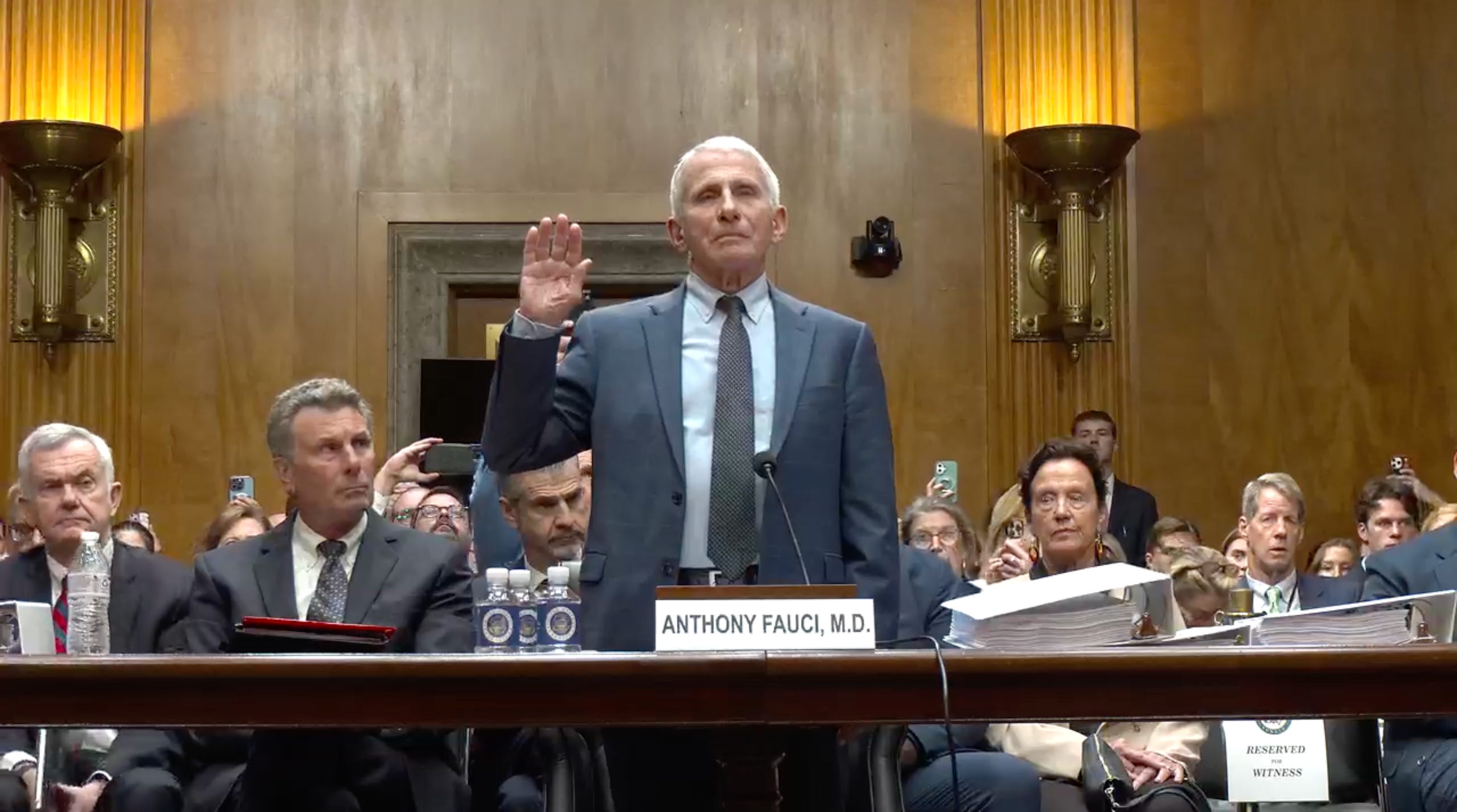
When Senator Rand Paul summoned Dr. Anthony Fauci to a congressional hearing this summer, it ended up triggering the latest test of the Justice Department’s obligation to wield its enormous power based on the law, not politics and revenge.
But this isn’t just another rule of law episode. The wrong decision by DOJ could weaken the government’s ability to protect the health of millions of American families.
Because Sen. Paul has repeatedly threatened to put him “behind bars” as part of the bitter political battles over COVID-19, Dr. Fauci invoked his Fifth Amendment right against self-incrimination more than 100 times.
The Supreme Court has repeatedly acknowledged that one of the basic functions of the Fifth Amendment is to protect the innocent. But it was clear that the hearing was designed to elicit answers that might not fully square with every other statement from Dr. Fauci’s half century of public service, especially in situations where changing circumstances during a health crisis can lead to evolving advice.
Such a discrepancy, routine in professional life, could these days trigger a prosecution by a Justice Department that has been vigorously pursuing the administration’s political enemies on baseless grounds.
When Dr. Fauci declined, Sen. Paul bypassed Senate procedures and called for the Homeland Security and Governmental Affairs Committee to hold him in contempt of Congress and refer the matter to the Justice Department—without the approval of the full Senate. It passed on a party line vote. (“Maybe he should” be prosecuted, said the President, who had cancelled Dr. Fauci’s federal security detail in January 2025 despite escalating personal threats.)
What will the Justice Department do now?
As the department’s former Director of Public Affairs and Acting Deputy Director of the Community Relations Service, I’ve seen the department navigate fierce political winds many times. I’ve also run and chaired the boards of nonpartisan nonprofits that work to uphold the rule of law, and protect democratic values from political pressure.
These experiences reinforce how the Fauci matter should be a no-brainer for the Justice Department.
Title 2 of the U.S. Code, first passed by Congress in 1857, requires that the entire Senate vote to refer contempt of Congress charges to the department. A federal appeals court in D.C. affirmed this requirement in the 1960s, as did the Justice Department’s Office of Legal Counsel under President Reagan.
But since 2025, a revenge docket has too often gotten top priority at DOJ, which has pursued a number of flimsy charges that would not have passed muster under previous administrations of both parties. Numerous perceived enemies have seen the government’s search light trained on them, including former FBI Director James Comey, New York Attorney General Letitia James, more than half a dozen Democratic members of Congress, and even a former Olympian who dipped his hand into the Reflecting Pool.
Grand juries and courts have done their job, tossing out these vengeance cases. But the bullying continues. For example, FBI agents and prosecutors are combing the records of at least eight scientists in the quest to prove that COVID-19 came from a leak from the Wuhan Lab. (Analyses by the National Institutes of Health and U.S. intelligence community suggest that the evidence points to natural causes.)
The persecution of government scientists isn’t just another black mark for the rule of law. As executive director of the O’Neill Institute for National and Global Health Law at the Georgetown University Law Center, it’s become dangerously clear to me how investigative bullying and revenge prosecutions are a growing threat to the health of American families.
Justice Department targeting of scientists will drive more of them out of public service, as a sequel to last year’s DOGE purges. That means fewer epidemiologists tracking the outbreaks of illnesses like measles and Cyclospora, a longer wait for guidance in an emergency, and fewer researchers developing the next life-saving treatment or vaccine.
If doctors, researchers and public health leaders censor themselves to avoid criminal threats, it will keep critical advisories from reaching parents trying to protect their children from a new virus, dangers at daycare, or poisoned food and water.
Making a career in public health less attractive means fewer researchers developing drugs to treat dangerous diseases and fewer nurses in overstretched hospitals. In our communities it means fewer local health workers monitoring our water and food, tracking outbreaks and inspecting restaurants. It means more health decisions tilted towards political favoritism and pressure.
It’s not that scientists, including Dr. Fauci, are perfect. Legitimate congressional oversight is critical to effective government. Proven criminal wrongdoing should be punished. But political targeting of public health professionals will only make it harder for Americans to stay healthy in a dangerous world.
As the O’Neill Institute’s founder Lawrence Gostin writes, “Framing public health decisions as matters of criminal intent rather than complex crisis management undermines public faith in medical recommendations, vaccines, and scientific consensus. It is also insidiously aimed at sowing public confusion and fueling the spread of false and misleading health information.”
If harassment of health officials and the denigration of science harden into permanent features of our politics, it won’t just threaten the health of our families. It will empower those working to tear down the psychology of honesty and good faith that underpins a democratic society.
We need our government focused on our health and rigorous science, not star chambers.
Americans need a Justice Department that will say no to political revenge that threatens our lives and liberties. And in the coming years, we need better guard rails to ensure that these dangerous follies can’t repeat themselves.
Bert Brandenburg previously served as the Justice Department’s Director of Public Affairs and later as Acting Deputy Director of the Community Relations Service. He is now the Executive Director O’Neill Institute for National and Global Health Law at the Georgetown University Law Center, where Dr. Fauci serves as a Distinguished Senior Scholar.
