

Justice Connection is publishing the following fact sheet to inform Congress, state and local officials, and the public of the traditional roles the U.S. Department of Justice plays in federal elections and what normal DOJ conduct — including from FBI agents — looks like.
DOJ plays a dual role in federal elections: protecting the right to vote and prosecuting violations of federal criminal laws involving election fraud.
For decades, DOJ’s position was that election fraud investigations should occur only after an election was certified, because the Constitution assigns the states primary responsibility for administering and deciding who wins elections — and because the mere existence of a federal criminal investigation could influence the election’s outcome. To ensure compliance with this approach, DOJ policy required prosecutors and FBI agents to consult with the department’s Public Integrity Section (PIN) — led and staffed by nonpartisan career prosecutors — before initiating or taking overt steps in an election fraud investigation.
Under the current administration, DOJ has abandoned its traditionally restrained approach. Longstanding internal policies governing DOJ’s role in election crime enforcement have been removed from the department’s website, and PIN has lost all but two of its attorneys through reassignments and forced resignations. In PIN’s place, DOJ political appointees will be calling the shots.
Meanwhile, DOJ threatened state election officials in every state with prosecution if they knowingly allow noncitizens to remain on their voter rolls, and sued California for failing to review a list of alleged noncitizens on the state’s voter rolls. The department also all but abandoned enforcement of the Voting Rights Act and voting protections, and it’s deploying 1,000 election monitors — who include, for the first time, DOJ prosecutors — to advance a spurious campaign to search for voter fraud. DOJ leaders have made clear that prosecutors who do not pursue reports of voter fraud will risk termination.
To help put DOJ’s actions this election cycle into context, here are some of DOJ’s traditional rules of the road.
Election Monitors
DOJ has long deployed Civil Rights Division attorneys to monitor compliance with federal civil and voting rights laws. Traditionally, DOJ has not used criminal prosecutors as election monitors to avoid potential voter intimidation. Among other constraints, DOJ monitors must remain outside polling places unless a state or local election official allows them inside. They must abide by federal laws against engaging in political activity while on duty, using their official position to interfere with the results of an election, and intimidating voters. DOJ monitors are different from federal observers, who are authorized by the Voting Rights Act and may enter polling places to observe the voting process, but are currently authorized to operate in only a handful of jurisdictions pursuant to court orders.
Armed Federal Agents at the Polls
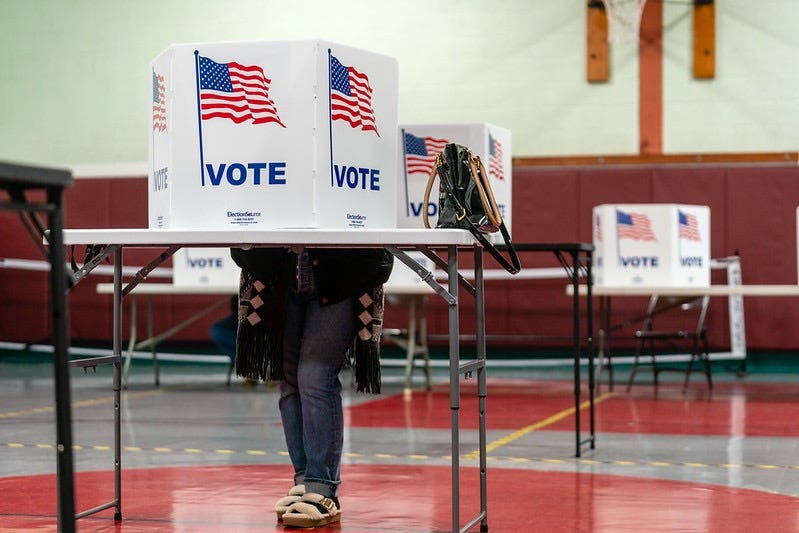
Federal law makes it a crime to station armed federal officers where general or special elections are being held. DOJ and FBI policy has thus traditionally required PIN to approve any investigative action that involves intrusion by federal investigators into the area immediately around a polling place because the statutory prohibition does not prohibit an armed federal response when a polling place has ceased to function because of a bomb threat or similar public safety issue.
Seizing Ballots and Election Materials
Seizing ballots and other election process documentation can deprive state and local election officials of materials they need to conduct recounts, resolve election disputes, and certify the winner of an election. For this reason, when DOJ needs to obtain election materials for an election fraud investigation, its traditional policy has been to accept copies in lieu of original election materials until a state’s need for the originals expires. This policy also provides that election materials should normally be obtained by a grand jury subpoena, consistent with federal regulations against using search warrants unless the use of a subpoena or other less intrusive method would jeopardize the availability or usefulness of the materials.
Election Fraud Investigations
For decades, DOJ followed a “non-interference with elections” policy meant to avoid inserting the department’s work as an issue in an election. The policy recognized that “starting a public criminal investigation of alleged election fraud before the election to which the allegations pertain has been concluded runs the obvious risk of chilling legitimate voting and campaign activities,” and “also runs the significant risk of interjecting the investigation itself as an issue, both in the campaign and in the adjudication of any ensuing election context.” Among other things, the policy reduced the possibility that malicious actors would generate false claims of fraud and use the imprimatur of a DOJ investigation to cast doubt on election results.
For these reasons, the policy generally prevented federal prosecutors and FBI agents from taking overt investigative steps — for example, voter interviews and grand jury subpoenas — until the election has been concluded, its results certified, and all recounts and election contests completed.
FBI Activities
The FBI had been the lead federal agency responsible for investigating foreign influence operations, which it ran through the Foreign Influence Task Force (FITF). The FITF was formed in late 2017 and disbanded under this administration. The FBI is responsible for working alongside other federal agencies to protect the election infrastructure against cyber threats and investigating federal laws regarding those who try to compromise voting systems and election related communication systems.
The FBI has historically utilized field office Election Crime Coordinators — both special agents and intelligence analysts — who are trained to assess allegations of voter fraud, civil rights violations, campaign finance crimes and other threats to both primaries and general elections. They serve as subject-matter experts and conduits to FBI headquarters, DOJ, and state and local officials.
Deciding Who Won
These and other longstanding policies reflect a fundamental principle: DOJ enforces federal law, but does not decide the outcome of an election. State and local election officials — and courts, where appropriate — determine voter eligibility under state law, count votes, certify results, and resolve legal disputes over election outcomes.
As we get closer to the election, it is, indeed, difficulty not to feel anxiety of what this lawless Administration will do. One thing we can not let it do is to cow us into not voting. Trump is at his lowest ebb ever as a politician with the lowest rating ever of any President. We know that he fears impeachment more than anything. The surest way for him to be impeached is for him to actively interfere with an election that reflects his unpopularity. It is stunning to have observed how, by his own actions, he has brought his own downfall. If, indeed, there is a real "blue wave" Trump risks this eventuality, particularly because his actions will have caused so many of his party in Congress to lose. The problem Democrats faced on the two occasions they tried and failed to convict the twice-impeached president is that there were not enough Republican Senators to vote to convict. That may not be the case this time. Dan Toomey