



More than 18 months into the second Trump Administration, it is clear that the administration’s immigration policies are taxing the federal courts and the Department of Justice more than any other area of federal court practice, and likely as in no other time in our nation’s history.
Although not surprising given the widespread media reports of overworked DOJ attorneys and Assistant U.S. Attorneys, the numbers shown on Justice Connection’s DOJ National Caseload Data Dashboard appear overwhelming. They reveal a picture of a Department of Justice being increasingly consumed by enforcement of the country’s complex immigration laws that’s far more aggressive than anything I saw during my 34 years of immigration enforcement at the department.
Civil Immigration Cases See a Major Increase
Most immigration cases are “civil” in nature. That is, they do not involve charging someone with a crime but instead involve non-criminal violations of immigration law, like overstaying a visa. Civil immigration cases also typically involve challenges by private individuals and groups to the actions and decisions of the Executive Branch. Most are defensive matters; that is, the government is the party being sued. Most are also handled by U.S. Attorney’s Offices across the country. When a civil case (including an immigration matter) is filed in a federal district court against the government, the nearby USAO is expected, per DOJ rules, to refer the matter to the department’s Civil Division, which is responsible for determining if the case will be handled by the Division or the local USAO. Traditionally, cases of national importance and those likely to set important precedent are the subset handled by the Civil Division, while the remainder are referred back to the USAOs.
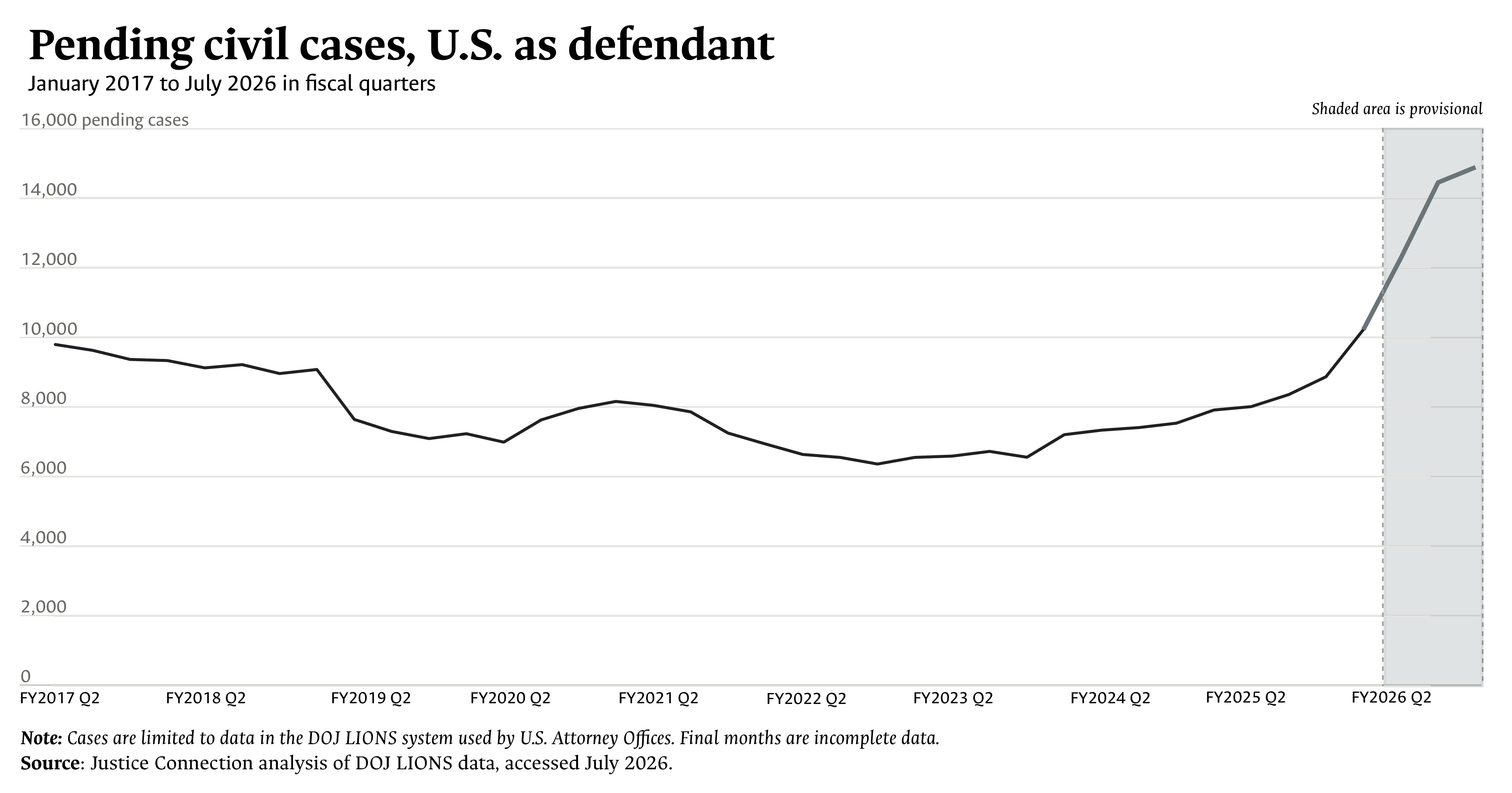
If the USAOs feel overwhelmed this year by the numbers of cases they are handling, the data explains why. By this past summer, there were more than 144,000 civil cases pending in federal district courts across the United States. That’s nearly a 72% increase in pending cases since January 2025, when there were slightly more than 80,000 pending civil cases nationwide (a number exceeded during the Biden Administration only in January 2021, when there were about 82,000 civil cases pending nationally in federal district courts – a slight uptick from the end of Trump I).
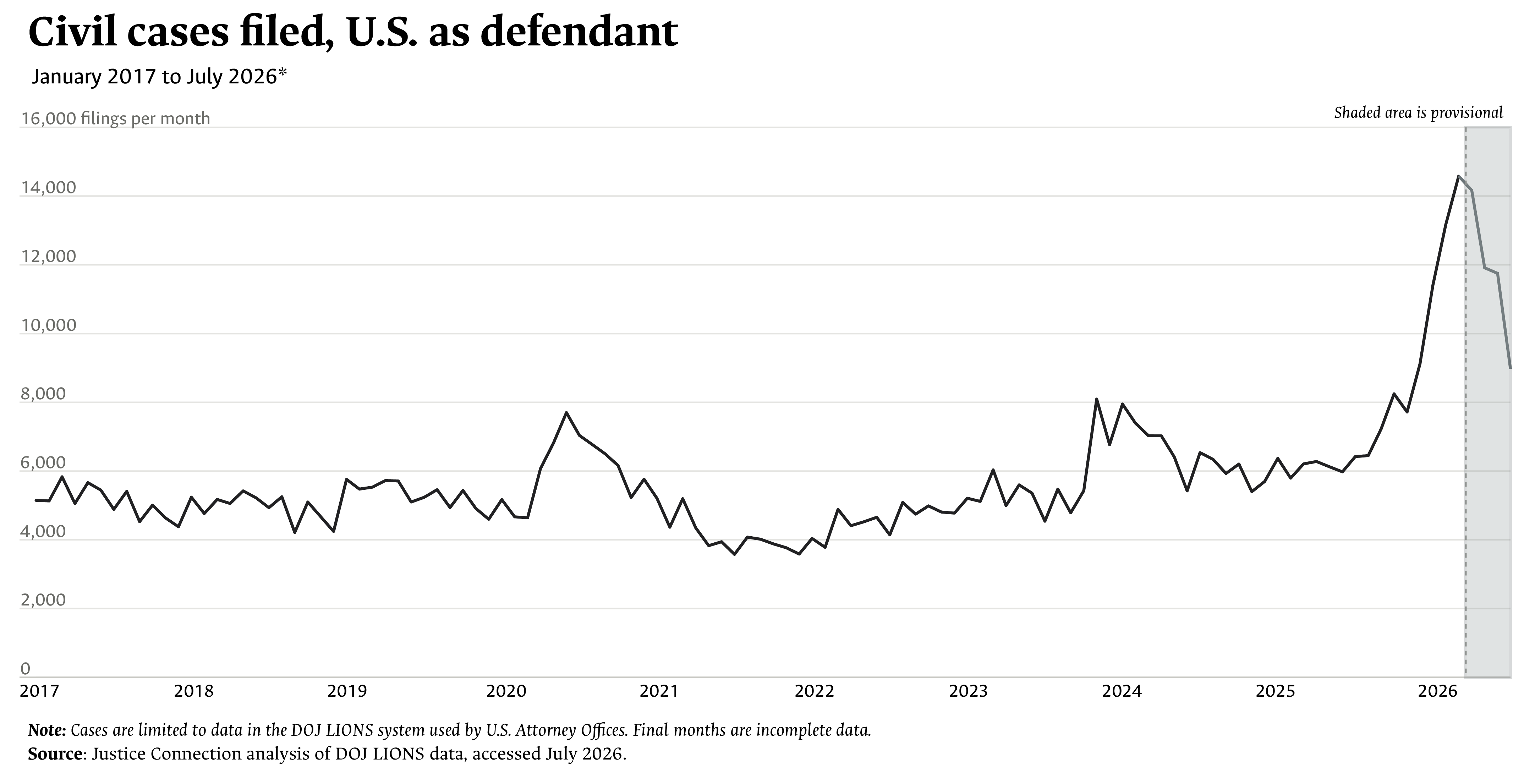
For most of this year, civil immigration matters have made up more than half of all new case filings. For example, in January 2026, new case filings reached 11,406 cases for the month, and 6,206 of those (54.4%) were in immigration matters. In March, total new filings surged to 14,581 cases, with 8,505 (58.3%) classified as immigration matters.
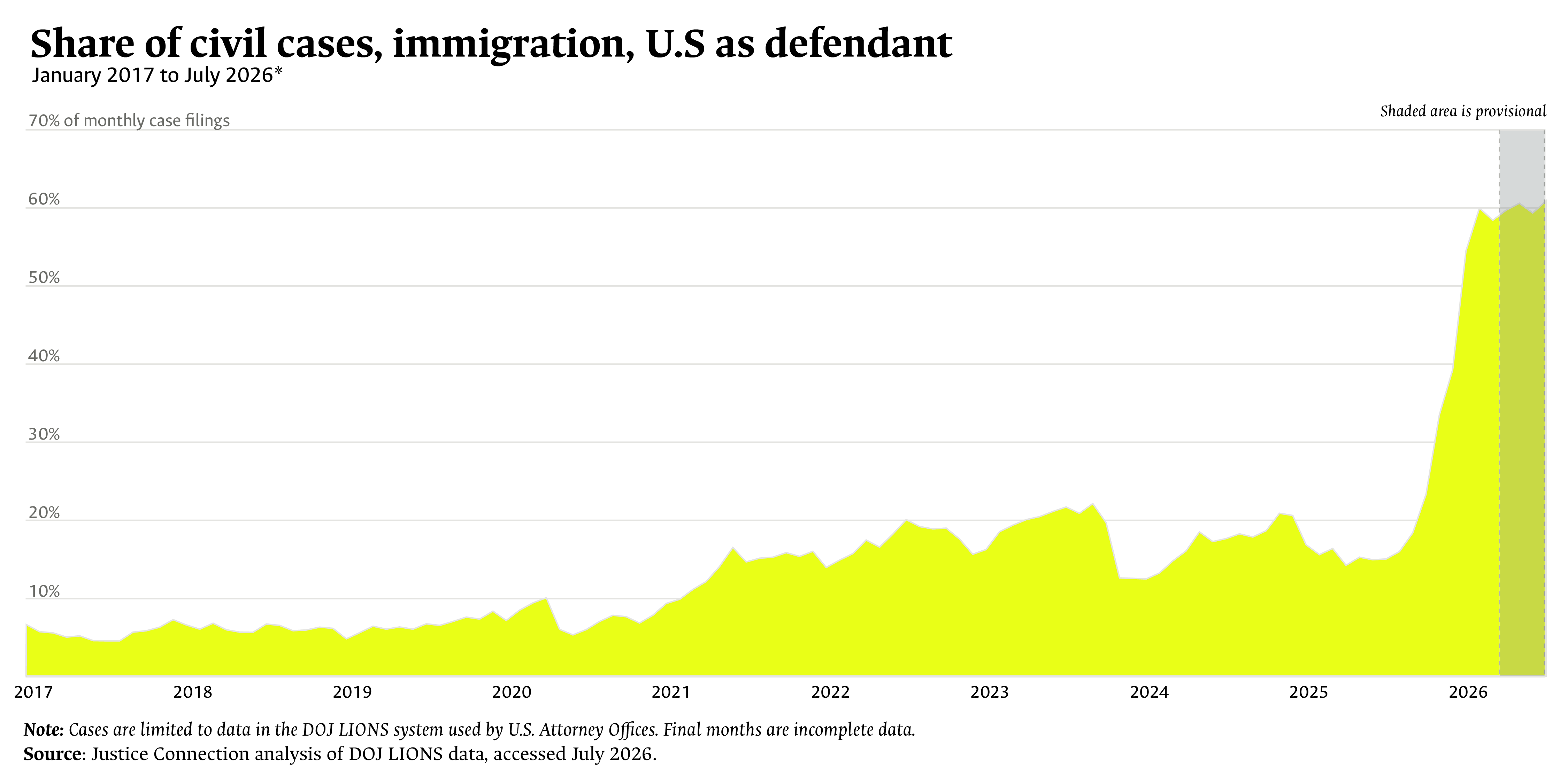
In contrast, from January 2021 to January 2025, there was an average of about 5,200 new civil cases filed each month against the government, and immigration cases never exceeded 23% of the total. Most months, the rate of immigration filings hovered around 17% (about 870 cases a month). New immigration case filings ranged from 846 in January 2024 to nearly 1,200 cases each month during President Biden’s final two years, with immigration cases making up between about 15-20% of the monthly totals each month.
In the first Trump term, the highest total of all new filings (that is, all case categories) occurred in June 2020, when 7,701 new civil cases were filed, and only 405 of those (or 5.3%) were immigration matters. The most immigration challenges filed in any month during President Trump’s first term was in April 2020, when 608 immigration cases out of a total of 6,076 (that is, 10%) were filed.
What’s Behind the Numbers?
Many of these matters now involve individuals challenging their immigration detention by the current administration, which has used the Immigration and Nationality Act’s detention provisions more expansively than past administrations, including in the first Trump term. In this term, the administration has asserted for the first time that individuals who cross the border without inspection are subject to mandatory detention, even if the border crossing occurred years ago.
The rise in immigration habeas petitions, which are challenges to detention, has been dramatic as a result (as has the rise in judgments against the United States in such matters). Many USAOs are feeling the pinch of rising immigration workloads while also trying to handle heavy workloads in non-immigration cases. But as staggering as the numbers are, they don’t even paint a complete picture of how often federal judges and DOJ lawyers, including those at USAOs and at “Main Justice,” are forced to deal with immigration issues in their day-to-day work.
On the civil side, there are undoubtedly several thousand more immigration cases flooding the federal appellate courts that originate at the circuit court level and not in district courts (and thus not reflected in DOJ data collected for cases that are filed first in district courts). That’s because immigration orders issued by the government – primarily removal orders rendered by the Department of Justice’s Board of Immigration Appeals – can be challenged by individuals who file petitions for review of those decisions in the federal circuit in which the petitioner’s administrative removal hearing before a federal immigration judge was completed. In any given year, the numbers are usually in the thousands – usually around 4,000 or 5,000 cases, though in some years the numbers of filings go much higher.
Changes in the government’s immigration enforcement policies – like the strict detention policies of the Trump Administration – can affect caseload numbers greatly. For example, after the September 11 terrorist attacks, the Department of Justice changed the regulatory procedures governing adjudications by the Board of Immigration Appeals. This caused the Board’s output to surge dramatically. In the following years, the heightened Board output caused a commensurate surge in annual filings in the appellate courts that reached unprecedented levels by mid-decade, one year alone exceeding 12,000 new cases filed.
Needless to say, such a dramatic surge over such a short period of time created a crisis not only for the federal judges forced to decide those cases, but also for the Department of Justice.
Normally such cases are handled exclusively by the Civil Division’s Office of Immigration Litigation (OIL), the office I led for 14 years. But at the height of the surge, then Deputy Attorney General James Comey took the unprecedented step of ordering all of the department’s litigating components to help OIL handle those cases, and many of the cases over the next several years were assigned to Assistant U.S. Attorneys nationwide. The situation was not considered ideal by anyone, especially by the USAOs and the federal circuit judges hearing the cases, who often complained that OIL attorneys were not available for court hearings in cases that had been delegated to the USAOs. The untenable situation resulted in Congress funding unprecedented numbers of new positions for OIL, more than tripling the size of its attorney staff to over 300 attorneys spread over two litigating sections.
A similar (though less dramatic) rise in appellate court filings occurred in the first Trump Administration. By the end of the administration, new petitions for review rose to about 7,000 cases, leading to expectations post-election in 2024 that OIL would again experience rising workloads in a second Trump term. When new filings in the circuit courts reach levels like 7,000 petitions per year, as undoubtedly they are reaching or exceeding again, the pace of filings puts great stress on an office that in this term has experienced a wave of departures, like many offices in the current DOJ.
When resources at OIL are stretched thin, OIL is not able to provide as much support to USAOs in the district court matters they are handling. As such, USAOs often complain about OIL (or other DOJ offices, as the case may be) not taking a “fair share” of habeas petitions, mandamus cases (involving claims of undue delay in immigration benefits processing), and other matters filed in the district courts. With the overall caseload numbers as high as they are now and with USAOs also experiencing attrition at high levels, those kinds of disagreements are undoubtedly on the rise.
Criminal Caseload Numbers
The data shows that Trump’s immigration policies are also having an outsized effect on how the Department of Justice’s resources are used in criminal cases as well. As on the civil side, most criminal cases involving the federal government are handled by USAOs. But unlike civil cases, criminal cases are affirmative in nature, meaning that the government files the case in order to prosecute an individual for committing a federal crime. In most administrations, the majority of federal prosecutions involve drug offenses, violent crime, and immigration prosecutions. Often there are high numbers of the latter because federal law criminalizes such offenses as illegal entry into the United States and illegal re-entry following removal, though the penalties for such offenses tend to be less than for other federal criminal offenses and thus prosecutors often seek to prosecute other crimes carrying stiffer penalties that are viewed as more serious federal offenses.
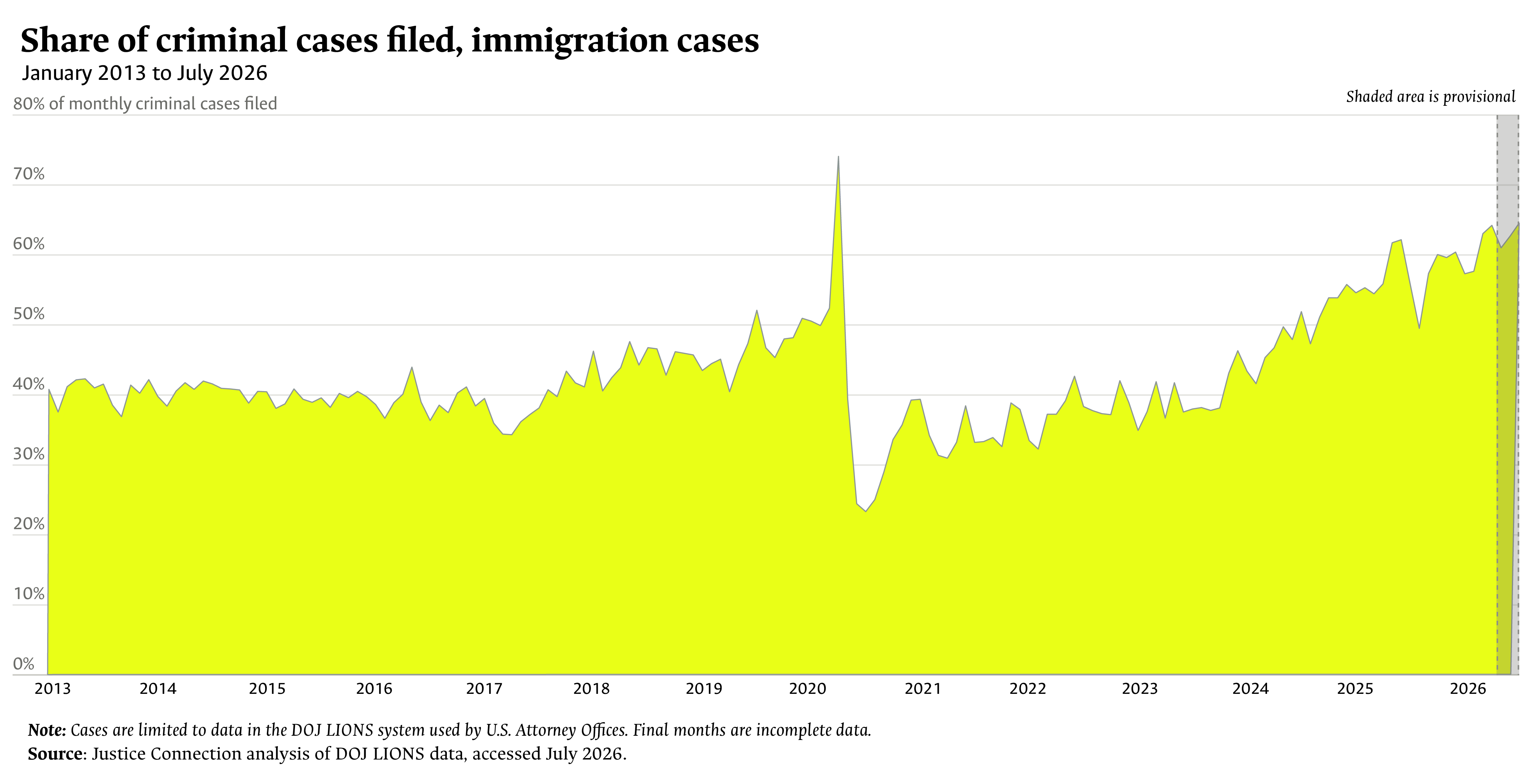
In Trump’s first term, prosecutions for border crimes fueled a rise in overall immigration prosecutions at the federal level, with many USAOs prioritizing such cases per administration policy, especially those districts at or near the southern border. The numbers again show that immigration prosecutions are supplanting prosecutions for other offenses, though the trend appears even more pronounced now, as the numbers show that about 60% of prosecutions involve immigration matters. In most administrations, including in Trump’s first term, such prosecutions have hovered around 40%. Criminal prosecutions reached a high in Trump’s first term in October 2019, when federal prosecutors filed 6,743 cases overall, with 48% of them (3,237) in immigration matters. The highest total of immigration prosecutions occurred in July 2019, when 52.1% involved immigration crimes (3,336 immigration prosecutions). In the current term, immigration prosecutions surged to 3,894 new filings in May 2025 (61.7% of the total).
Conclusion
Although caseload totals are high across the Department of Justice and the USAOs, whether they are dealing with civil or criminal matters, department attorneys and AUSAs no doubt are doing their best to stem the tide of rising workloads. The talented professionals in the USAOs and across the Department of Justice are used to doing so, and OIL attorneys and USAOs are used to doing their level best to provide sound representation for the government in the immigration cases that reach (and often saturate) the federal courts. They are likewise used to sorting out inter-office disagreements over case handling decisions and utilizing their resources as best they can.
On the other hand, since the start of the current administration, there have been an average of about 8,800 civil cases filed each month, and the number of pending matters has climbed nearly every month since January 2025, from a low point of about 80,000. Immigration cases alone have accounted for more than 67,000 of the new cases filed between January 2025 and July 2026. If the numbers continue on the same path, and with immigration cases as a major driver of high numbers in the federal courts, one wonders how long those attorneys can reasonably be expected to meet the challenges of that daunting caseload.
David McConnell is a former Director of the Office of Immigration Litigation in the Civil Division of the Department of Justice. He retired from a 40-year government career in February 2025 after 14 years as the OIL Director and 34 years in OIL overall.

To add insult to injury they fired so many people back in 2025 ( or they left) that they are really understaffed. I was there in 2023 through May 2025. Eventually; the DOJ focus just went beyond my morals.