

Misconceptions About the Role of the Career DOJ Attorney
DOJ career attorneys aren't "Deep State" saboteurs or "compliant minions"—they're bound by ethics & law. 5 former Civil Division leaders debunk both misconceptions & discuss the dangers posed.


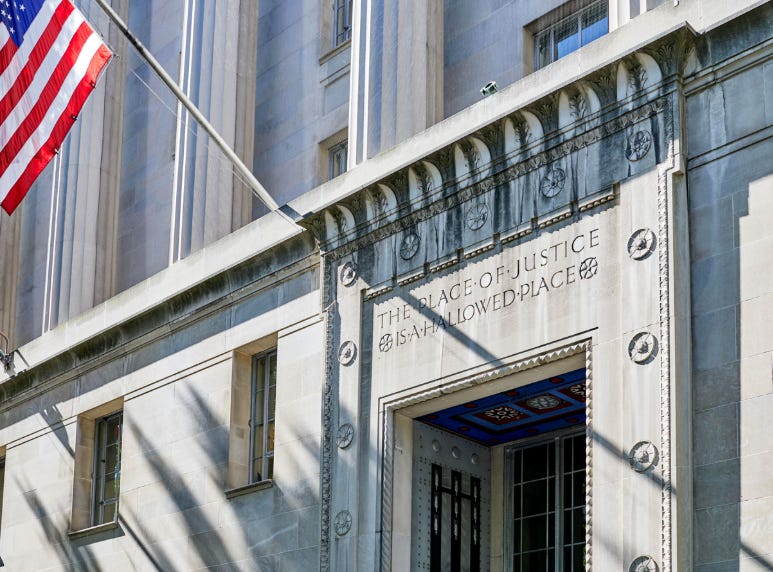
When the chorus condemning a supposed “Deep State” in government first arose, we shrugged it off as misinformed. In our experience – combined, well over a century’s service in the Department of Justice Civil Division – civil servants endeavored in good faith to carry out and defend the laws enacted by Congress and the policies put in place by an administration. The idea that cadres of conspiratorial civil servants maneuvered behind the scenes to undercut their political leaders seemed far-fetched.
Yet in recent months, our former colleagues have been denounced from one end of the political spectrum to the other. The drumbeat of a “Deep State” has persisted, and as a result career attorneys have been sidelined, reprimanded, and even terminated for perceived failures to “zealously advocate” for the Trump Administration in court. Ironically, at the same time, some opponents of the Trump Administration have characterized career attorneys as compliant minions willing to violate rules of legal ethics to advance the Administration’s goals.
Neither of these aspersions is true. And both reflect ignorance of what career Civil Division attorneys do and cannot do.
The Deep State Bogeyman
The Justice Department Civil Division is a unique institution in government. Much of its work involves defending, on behalf of the United States, lawsuits challenging official actions by the President, other senior officials, and more than a hundred federal agencies in high-profile cases addressing the lawfulness of federal actions, policies, and regulations. We ourselves personally defended and supervised litigation involving politically divisive issues of health care, education, immigration, national security, and military service, among countless others. Civil Division attorneys carry on that work today.
And while we cannot speak categorically for every agency of government, we can say with confidence that the “Deep State” epithet has no application to the career DOJ attorneys with whom we worked. In fact, this perspective has from the beginning reflected a profound misunderstanding of a DOJ attorney’s role.
We defended the policies of the Biden Administration, just as we had those of President Trump before him, and those before of Presidents Obama, Bush, Clinton, and so on. Each Inauguration Day when a new administration took the reins, career DOJ attorneys stood ready to defend suits that threatened the administration’s ability to govern effectively in accordance with its view of the public good, whether that meant defending the Affordable Care Act, NSA surveillance, or decisions to build, or not to build, a border wall. Understanding this, most of the political leadership we served under at DOJ placed their trust in the career attorneys and welcomed the benefits of their institutional knowledge and expertise.
To be sure, as the White House changed hands between the Republicans and the Democrats, we occasionally encountered suspicion from political appointees who wondered how we – who had worked with their political foes in a prior administration – could possibly serve their interests now. But typically, those misgivings soon dissipated. Our new leadership quickly understood that, just as we career DOJ attorneys defended the actions of earlier administrations, we would similarly be prepared to defend the actions of a new administration so long as there were reasonable legal and factual bases to do so. We did that not because we necessarily agreed with the actions taken by each administration, but because it was our legal and professional responsibility to provide every administration the best representation that we were capable of.
Attorneys Have a Duty to Provide Candid Advice to Their Clients
But when career DOJ attorneys advise agency officials that a new policy may be legally unsound, suggest that the policy be modified, or recommend that an agency support it with a more robust analysis, they are not failing to zealously advocate for a cause. It’s actually the opposite – they are trying to convey information that agency officials need in order to make sound decisions that are more likely to prevail if challenged in court.
Under the rules of professional conduct, litigation counsel has a duty to consult with a client to help the client make informed decisions about a case. Counsel is additionally required by the rules to give the client candid advice: straight talk reflecting counsel’s honest assessment of the prospects for success; of considerations, whether legal, social, political, or otherwise, that could influence how the law is applied in the client’s case; and of unpleasant facts and alternatives that a client may not want to confront.
These duties of consultation and candor are intended to protect the client’s best interests. That effort should not be condemned as disloyalty, or as an attempt to subvert the political will of the democratically elected president. Enlightened leaders recognize that “speaking truth to power” serves their interests and should be welcomed, not punished.
Attorneys Have Ethical Lines They Cannot Cross
It must also be understood, however, that there are legal and ethical limits to what lawyers can do to protect and advance the interests of their clients. The obligation that lawyers have to a client is subordinate to rules of professional conduct designed to protect the integrity of the judicial process itself.
The rules provide that litigation counsel, as officers of the courts in which they appear, may not bring or defend a case, or contest a particular issue, without a non-frivolous basis in law and fact. Doing so constitutes an abuse of the legal process. A lawyer also may not knowingly make false statements of fact or law to a court, or present or rely on evidence the lawyer knows to be false. In addition to this duty of candor, Rule 11 of the Federal Rules of Civil Procedure requires attorneys to certify, to the best of their knowledge, information, and belief, after reasonable inquiry, that the arguments contained in their written submissions to a court are legally warranted and have evidentiary support.
The rules are not mere guidelines. They are legally binding on all lawyers. Compliance is not optional. The rules are enforceable by state bars or other disciplinary authorities having the power to investigate alleged attorney misconduct and impose disciplinary sanctions. A finding that an attorney has violated the rules of professional responsibility can lead to career-threatening results, including censure, suspension, or disbarment. Moreover, government lawyers are statutorily required by the Ethics in Government Act to adhere to the standards of conduct prescribed by state ethics rules. Rule 11 is also judicially enforceable, and violations can result in stiff monetary sanctions, including payments of attorneys’ fees and other expenses to an opposing party, based on judicial findings of misconduct that could also end a career.
Simply put, attorneys cannot permit themselves to act as mere conduits of a client’s unsupported assertions. So if an agency formulates a new policy without sufficient consideration of the relevant legal constraints, or without developing an adequate factual record to substantiate the justifications on which the policy is based, then DOJ counsel cannot present spurious legal arguments on the agency’s behalf, or manufacture evidence that simply doesn’t exist.
In our experience, career DOJ attorneys abide by these rules not simply out of concern for their own professional welfare, but also because they honor the ideals for which the rules stand: protecting the client’s interests and defending the integrity of the judicial process. Demands for “zealous advocacy” cannot overcome these ethical obligations and court rules. And no career attorney’s livelihood should be threatened because they refuse to abandon these fundamental principles.
Guilt by Association
Unfortunately, misperceptions about the role of career DOJ attorneys are not confined to the “Deep State” chorus. Also misguided are the Trump Administration opponents who accuse career attorneys still serving under the current Administration of complicity in its misdeeds.
We share the antipathy of these detractors toward many of the Administration’s policies and methods. But their anger toward career DOJ attorneys, and the actions they have taken against these career attorneys are woefully misdirected.
For example, some of the Administration’s ideological opponents have taken up “name and shame” tactics. They compiled and published online rosters that individually identified and denounced the Civil Division lawyers who had been tasked with defending Administration policies that the authors of these publications unilaterally deemed unlawful, reprehensible, or otherwise unworthy of any legitimate legal defense. We have also seen bar complaints filed against career Civil Division attorneys for allegedly submitting misleading testimony to a court – without any findings or even an accusation by the court that the government’s attorneys had attempted to deceive it.
As longtime Civil Division lawyers, we are used to opposing counsel failing to understand how career attorneys could defend policies our opponents considered odious, such as protecting abortion rights or gun rights in one administration, and then defend restrictions on those very same rights in a later administration. We have been labeled by our opposing counsel as agents of the “Clinton Justice Department” and later of the “Bush Justice Department,” both intended as insults.
Like our former adversaries, some opponents of the Trump Administration fail to grasp that Civil Division lawyers responsible for defending the interests of the United States in court are obligated by the rules of professional conduct to provide competent representation to their agency clients, requiring thoroughness, preparation, and diligence. They have a corresponding duty to use all available legal procedures for the fullest benefit of a client’s cause, and to present the client’s case with persuasive force. These duties do not ebb and flow depending on an attorney’s personal ideology or political preferences, or those of the Administration under which an attorney currently serves.
Of course, as we’ve outlined, these duties of zeal, as they are known, are subordinate to and limited by counsel’s duty of candor to the court. As noted, counsel must present arguments that have a good faith basis in law, and cannot knowingly make false statements to the court or knowingly present or rely on false evidence. But the rules of professional conduct also recognize what the Administration’s detractors seemingly do not: A lawyer’s defense of even an odious policy does not mean they necessarily endorse that policy, just that there is a good faith argument that the policy is lawful – a question for the court to decide.
And if there is concern that counsel has misstated the facts or submitted false evidence, the presiding judge in a case, who will already be deeply familiar with the relevant proceedings and evidence, is best suited in the first instance to assess whether counsel have strayed from their obligations. Indeed, in our experience, courts at all levels hold government lawyers to even higher standards of ethical conduct than private counsel, precisely because they are supposed to represent the public interest.
Moreover, as we have seen in our own years of practice, misstatements to a court can be products of innocent mistakes on counsel’s part, caused by the speed with which filings must be made in fast track preliminary injunction proceedings, a client’s failure to convey certain facts whose salience it fails to appreciate, or a client that has withheld certain facts from counsel in the (vain) hope that keeping its lawyer in the dark will improve its chances in court. None of these circumstances would constitute a knowing ethical violation by counsel, let alone one worthy of bar discipline proceedings. In any event, federal judges have the tools at their disposal to determine whether ethical requirements have been violated in their courtrooms.
A Final Word
In sum, supporters of the Trump Administration would do well to recognize and better understand the role of career Civil Division counsel. These attorneys are required to conform their representation to the letter and spirit of the ethical standards of the legal profession. Doing so is not an act of disloyalty by so-called Deep State operatives but instead serves to ensure that an administration’s lawful objectives are best achieved.
Similarly, opponents of the Trump Administration should recognize that dedicated career attorneys, who must defend highly controversial, fast-moving cases against the Trump Administration, are obligated to present reasonable defenses to challenged policies, even controversial ones. Doing so is not an endorsement of policy goals, and any concern with their statements or actions is subject to the court’s supervision.
And all need to understand that denigrating or shaming these career civil servants, from inside or outside of government, will serve no purpose except to drive more of the dedicated public servants with whom we served out of government, to the detriment of DOJ, the judicial process, and the rule of law.
Jennifer D. Ricketts, Branch Director, Department of Justice, Civil Division, 1989-2024
John R. Griffiths, Branch Director, Department of Justice, Civil Division, 1998-2025
Anthony J. Coppolino, Deputy Branch Director, Department of Justice, Civil Division, 1988-2023
James J. Gilligan, Special Litigation Counsel, Department of Justice, Civil Division, 1991-2024
Carlotta P. Wells, Assistant Branch Director, Department of Justice, Civil Division, 1990-2024
 | A guest post by
|
 | A guest post by
|
 | A guest post by
|
 | A guest post by
|
 | A guest post by
|
Well said. Let’s hope the damage to the federal government agencies, and especially the DOJ Civil Division, Federal Programs Branch, is temporary and it can soon return to excellent advocacy on behalf of the public interest.
Hello to Jennifer Ricketts who I got to know when she headed Federal Programs. She’s an excellent attorney and was a great resource for me. Ann Harwood