



Last week, The New York Times published an in-depth look at who the Justice Department has hired to fill the depleted ranks of the Civil Rights Division, which lost approximately 75 percent of its attorneys since January 2025.
After pushing out upward of 300 nonpolitical career employees, the Civil Rights Division has since hired 126 people, many of whom, the Times reports, with backgrounds that likely would have disqualified them from being hired in the past. The Times also notes that they have “rejected nearly as many applicants as they have hired,” which means that the pool of candidates is extremely small if the division is hiring one out of every two applicants.
The story illustrates an important need to better understand how the Justice Department’s workforce has changed, and how that workforce compares with prior administrations.
Justice Connection has created a new dashboard built from monthly data published by the U.S. Office of Personnel Management that makes this analysis easily accessible.
In April, we published a post from former FBI analyst Philip Fields that showed trends in departures at the Justice Department during the first year of the administration. This new dashboard builds on his work and will be updated each month as OPM releases new data.
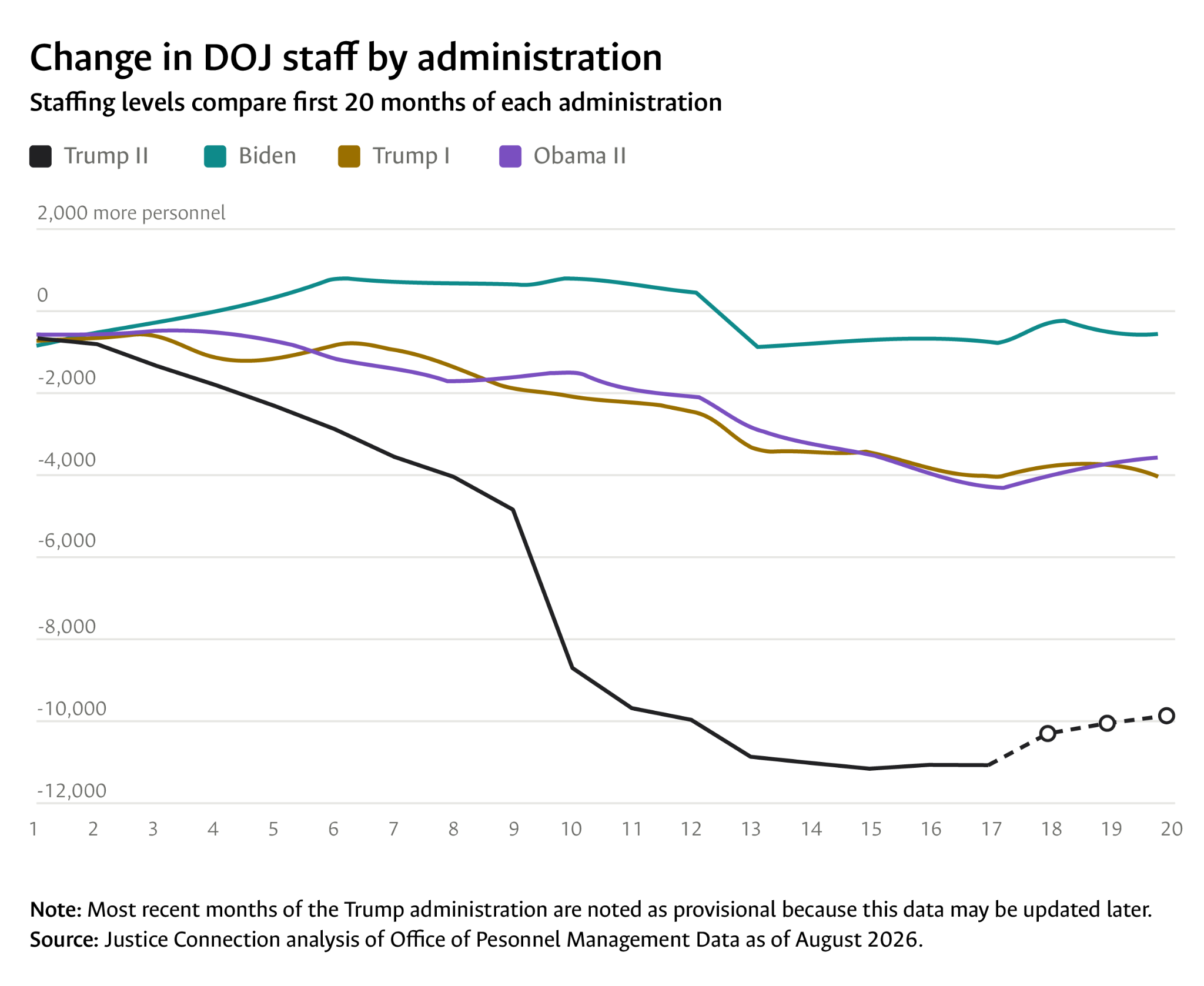
According to OPM’s latest data, the Justice Department is still experiencing an exodus of career staff: 21,244 departures so far, including 4,333 attorneys — nearly triple the rate of attorneys who left under the first Trump administration. It also includes 2,836 federal agents, including 1,604 from the FBI.
People come and go from the department in every administration. But the data shows that the number of departures combined with new hires reflects an unprecedented change in the overall workforce at DOJ.
Shrinking Litigation Workforce
One of the hardest hit areas is attorneys from the boards and divisions at DOJ’s headquarters, known as Main Justice. More than 1,700 attorneys have left, representing a departure rate of 32 percent, compared with 3 percent in the first Trump administration. So far, only 464 attorneys have been hired to replace them.
And while the loss of these attorneys has hit the department hard, compounding the problem is the high number of paralegals who have also departed. Paralegals are an essential part of the department’s work. They provide support to attorneys by conducting legal research, drafting legal documents, managing case files, and organizing trial preparation.
Almost 600 paralegals have left, and only approximately 180 have been hired to take their place. The departure rate for paralegals in this administration is nearly double that of any previous administration in OPM’s records.

Political Appointees Dominate Senior Positions
Another significant change is the shrinking number of career employees in the Senior Executive Service, especially at Main Justice. There are 40 percent fewer career SES now at DOJ’s headquarters than at the start of the administration. With 130 currently on staff, that is significantly lower than any of the previous administrations: 196 (Obama), 213 (Trump first term) and 217 (Biden).
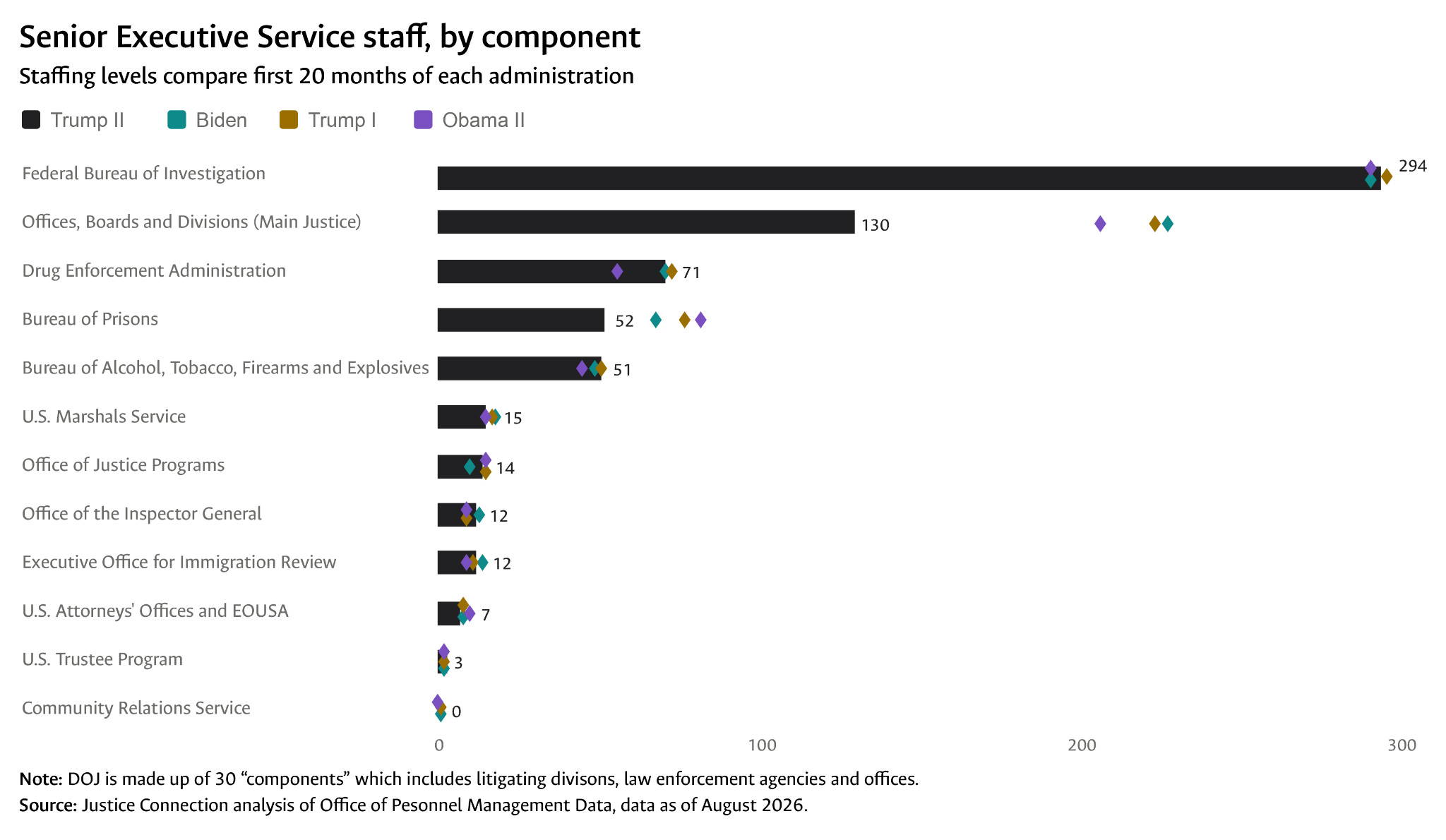
The career SES role is vital at the department. These are the most experienced and trusted career staff, who prior administrations relied on to provide counsel and guidance to avoid mistakes and ensure the department’s actions complied with the law and court precedent.
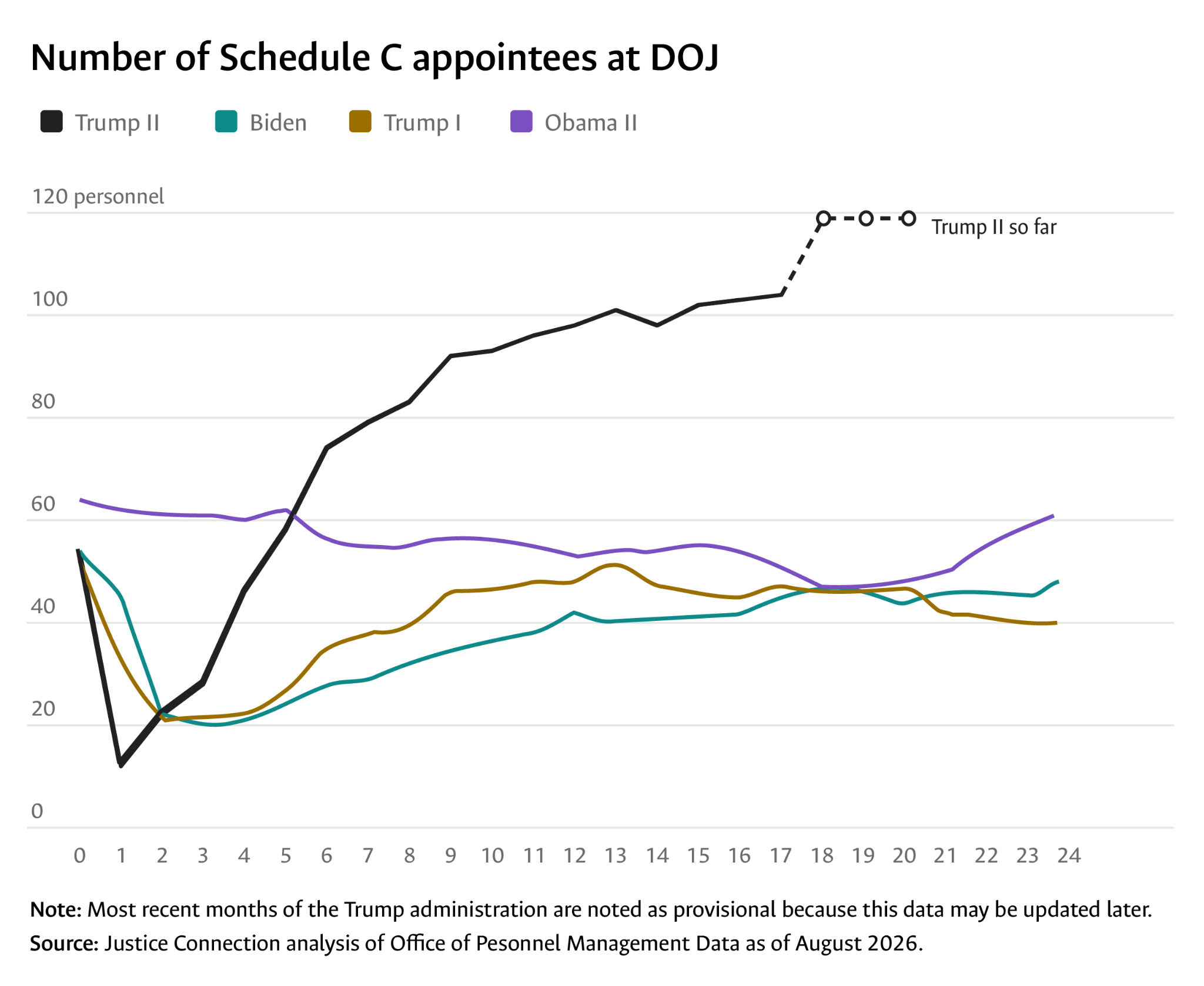
This purging of career SES staff is happening at the same time that the administration has dramatically expanded the hiring of Schedule C political appointees. These are non-Senate-confirmed political positions at the department, a role created to help political leadership carry out the President’s goals within federal agencies.
The number of Schedule C hires at the Justice Department has exploded, from an average of 45 in prior administrations to nearly 120 now.
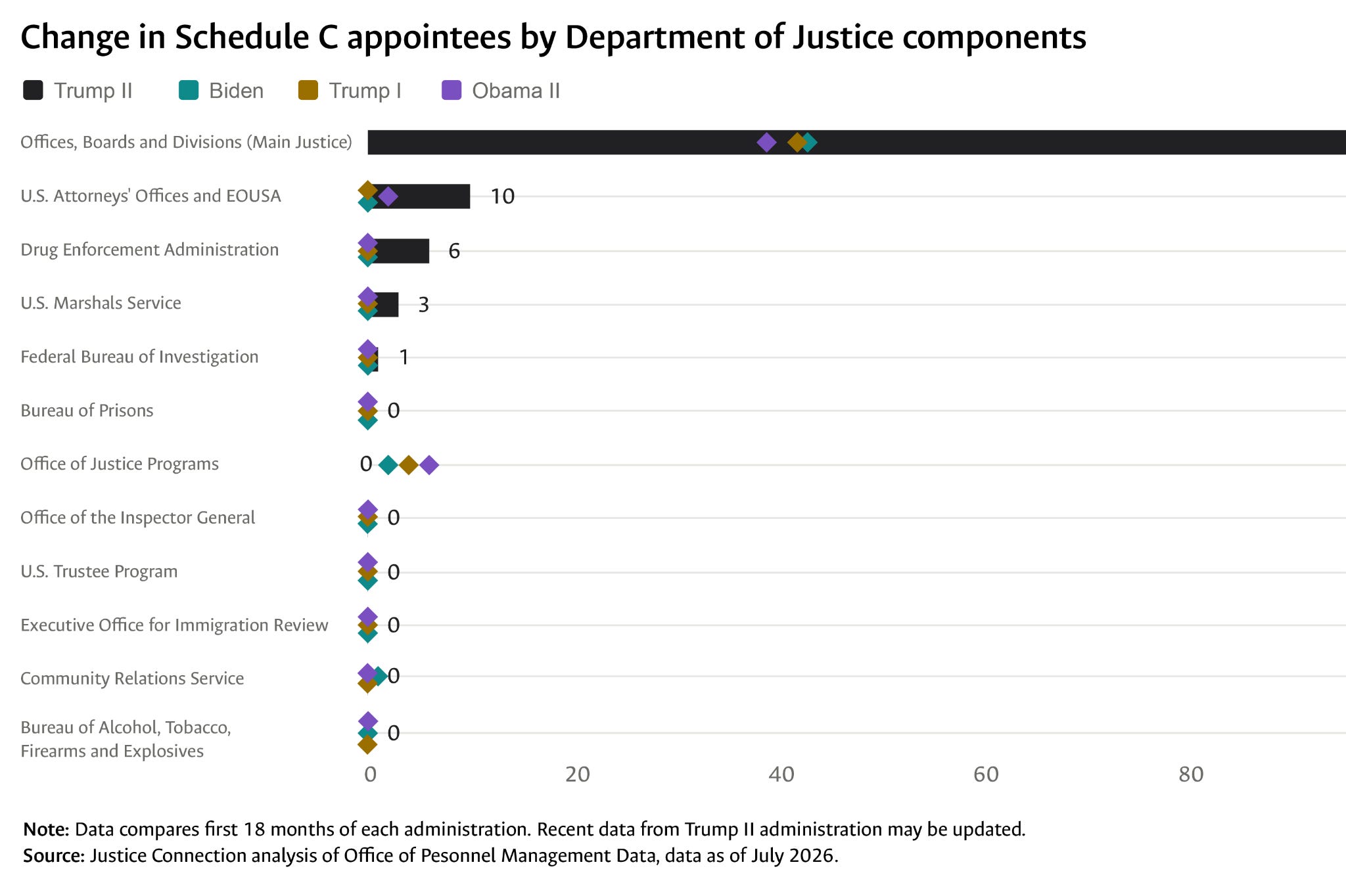
In prior administrations, nearly all Schedule C appointees worked at Main Justice. Now, however, we are seeing Schedule C hires at levels never seen before in the U.S. Attorney’s Offices and also for the first time at the FBI, U.S. Marshals Service, and DEA.
Why This Matters
This reliance on Schedule C hires is troubling for an institution that lists as its first core value “Independence and Impartiality.”
I joined the Justice Department as a political appointee under President George W. Bush. When I became a career civil servant, I served alongside political appointees from Republican and Democratic administrations. They were good people, who, for the most part, put their partisan backgrounds to the side because they understood the unique role the department played in upholding the rule of law.
That said, the department’s political leadership is operating in blatantly partisan ways to a degree never seen in the department’s history. My experience in the first months at the department under the current administration and speaking with those still there indicates that many of the recent political appointees do not see their partisan roles changing now they are in the department. In fact, current and former top DOJ officials under this administration are openly encouraging partisans to apply for career jobs.
The Justice Manual states that “The rule of law depends upon the evenhanded administration of justice. The legal judgments of the Department of Justice must be impartial and insulated from political influence. It is imperative that the Department’s investigatory and prosecutorial powers be exercised free from partisan consideration.”
It goes on to say that “The success of the Department of Justice depends upon the trust of the American people. That trust must be earned every day. And we can do so only through our adherence to the longstanding Departmental norms of independence from inappropriate influences, the principled exercise of discretion, and the treatment of like cases alike.”
The continued push to drive the apolitical, nonpartisan employees from the department while expanding the use of those hired from the White House hiring pool is eroding that public trust.
You have identified the most meaningful and, of course, deeply troubling staffing trends; thanks for this insight. Two points of emphasis from my experience as a first-line supervisor in the Criminal Division -- first, the depletion of career SES attorneys is particularly harmful because that layer of oversight and management buffers pure political decision-making from criminal investigations and prosecutions at the line. When that buffer leaks, political partisanship invades even-handed law enforcement decision-making. Secondly, in addition to the Civil Rights Division, I have seen hiring choices made in the Criminal Division (CRM) over the past year that would never have occurred in previous administrations. CRM is hiring into career slots inexperienced prosecutors with unspectacular credentials who are motivated by the opportunity to work on politically-driven cases. They sorely lack of the foundation of experience, integrity and judgment that many of us cultivated each and every day on the job. When the current administration exits, it is going to be really challenging to restore the Department's integrity and public trust with this cadre of questionable hires remaining in the wake.
This is so important, thank you.