


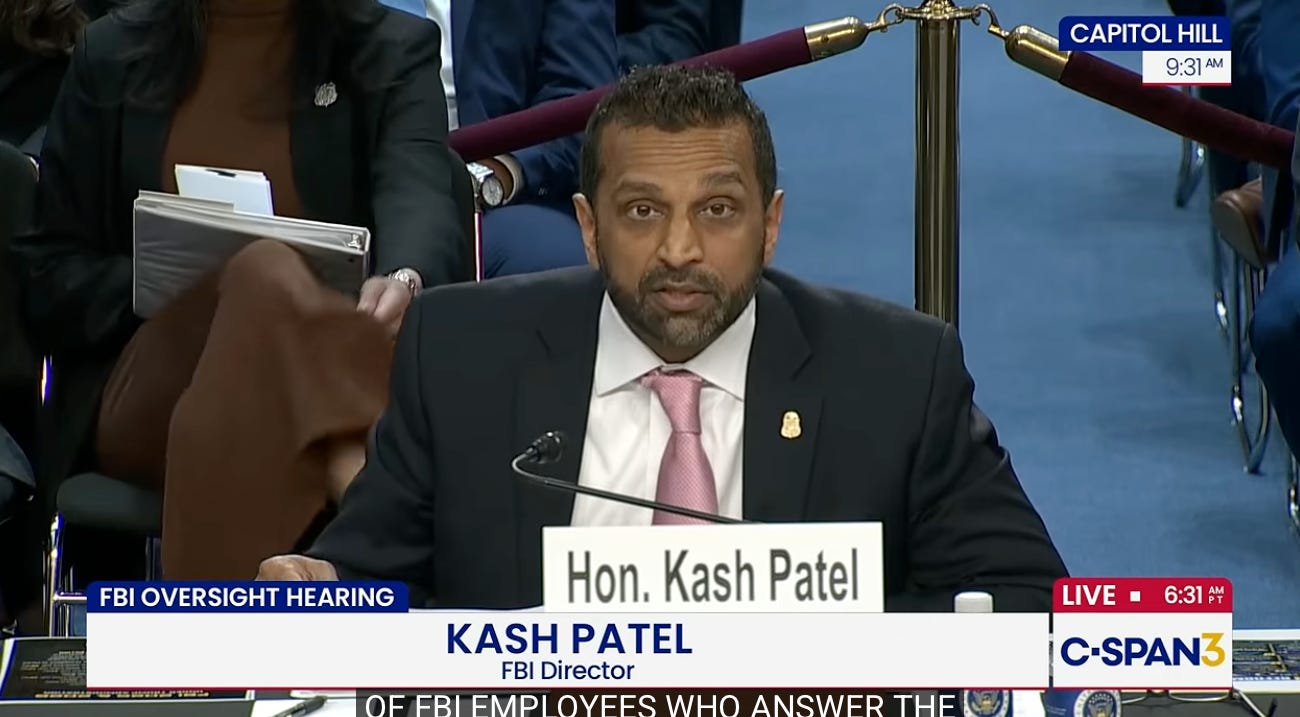
Of all the lessons I learned in 26 years as a special agent of the FBI, the importance of candor—the ability to speak the truth—was the most essential. There was a simple enough reason for it. Everything about the FBI—its motto (Fidelity, Bravery, Integrity), credibility, reputation, even its mystique—stemmed from it.
In fact, lack of candor could get you fired.
After hearing about, and listening to, as much as I could bear of the current FBI Director’s sworn testimony before the Senate Judiciary Committee a few weeks ago I have to wonder if that is still the case. For one thing, he claimed that the FBI arrested 54,000 violent offenders in 18 months—a supposed 90% increase. Justice Connection did some digging and found that number highly improbable given the data DOJ itself puts out.
It’s hard to take someone seriously when they are touting numbers that are seriously suspect. It’s been widely reported that agents who have been participating in mass immigration arrests under the current director’s watch were ordered to claim statistical accomplishments for merely being present, or assisting, in another law enforcement agency’s sweeps.
But questions about the validity of the numbers aside, the bigger issue is what happens to partnerships with state, local, and other federal agencies when those partners realize the FBI is taking credit for their work.
Recall another time in FBI history when a director routinely, and wrongly, stole the fruit of someone else’s labor. It occurred in the years following the Dyer Act, which made taking a stolen car across state lines a federal offense. On a regular and ongoing basis, J. Edgar Hoover ordered FBI special agents to claim recovery stats not only for stolen cars they located, but those recovered by local police departments, as well. The FBI then presented those stats to Congress as evidence of its own accomplishments—a manipulation that not only heightened the Bureau’s public profile, but gained it additional resources. It took decades for the FBI to rebuild relationships with local and state police departments that were burned by the FBI’s actions and left suspicious about its motives. And lest anyone think this is just another Bureau urban legend, I experienced the lingering distrust firsthand as a brand new agent, supervisor, and even Special Agent in Charge, nearly a hundred years later.
Sadly, it appears history is repeating itself. The drop in homicides that the current director reported is truly a noteworthy accomplishment. Americans are safer.
But it should have been noted that the decline in murders actually has little to do with the FBI.
With rare exceptions, the FBI doesn’t do homicide investigations. And even in regard to those exceptions, the response is almost always reactive. They are called in by local, state, military, or tribal law enforcement after a homicide to assist.
The real story behind the current decline is complex, but two things are indisputable. One, the numbers are reflective of a decades-long decrease (with the exception of a spike during the pandemic) in the homicide rate in America. And the second is that state and local police jurisdictions, not the FBI, are generally responsible for investigating homicides in this country. As noted, the FBI can, and often will, assist in certain instances, but it’s the “locals” who do the heavy lifting. They’re the first responders, they have the investigative expertise and they, along with their city leaders, are the ones who formulate and implement the plans, policies, and procedures that allow them to combat the problem.
It follows that they should get the lion’s share of the credit when they are successful.
Which is why the current director’s claims that he, and the administration he serves, are responsible for bringing the violent crime rate down in America isn’t just bad theater, but a serious lack of candor.
It also does a great disservice to the thousands of dedicated FBI professionals who not only work with those same state and local law enforcers every day, but have to live with the consequences of his antics.
Frank Montoya Jr. is a 26-year veteran of the FBI, with service as a criminal agent and in the national security realm.
