


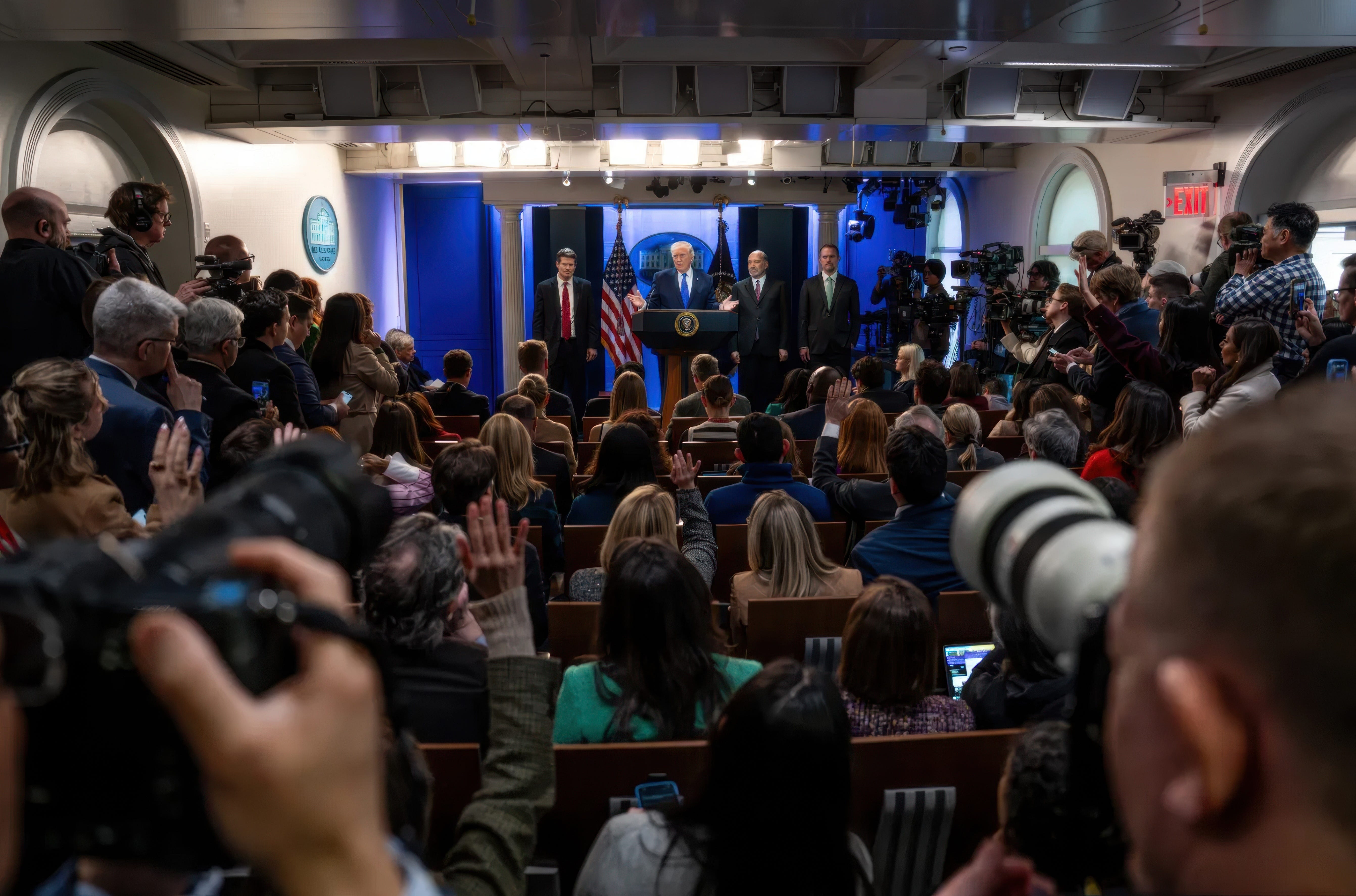
Live TV news coverage involves a three-person crew — a camera operator, an audio technician, and a producer or reporter. Cost considerations and space constraints led TV networks to form a pool and take turns covering many presidential events. The White House TV pool currently consists of ABC, CBS, CNN, NBC and Fox News.
At 3:04 p.m. on Friday, Sept. 18, President Trump barred CNN (plus MS NOW and POLITICO) from the White House.
On Monday, Sept. 21, CNN was responsible for staffing the pool but was not permitted to do so. Pool chair Bryan Boughton (Fox News Washington Bureau Chief) announced that the pool “will not be covering events designated as pool coverage of the President.” Presumably, this announcement was agreed to by the TV pool networks.
On Oct. 9, the Justice Department’s Office of Public Affairs revealed a civil antitrust investigation and stated: “Members of the television press pool have boycotted covering White House events. Group boycotts among commercial competitors can violate the Sherman Act. The Antitrust Division is simply investigating to determine whether these news organizations have violated the antitrust laws.”
Although the foregoing statement can be found on hundreds of websites, the DOJ site is not among them.
The Sherman Act was the first federal antitrust law and remains the most important. Because the Sherman Act’s prohibitions were drafted in broad language, antitrust law developed as common law, and courts have held that “group boycotts among commercial competitors can violate the Sherman Act.”
But a court would not find that the TV pool members violated the Sherman Act by engaging in a group boycott.
A legal system respecting the rule of law condemns conduct only when established criteria are met, and under antitrust law, the criteria relate to substance rather than form. The Sherman Act condemns price fixing as unlawful per se, but the Supreme Court held that the blanket licensing of music libraries by ASCAP and BMI was not per se unlawful price fixing, even though a price literally was fixed. Broadcast Music, Inc. v. Columbia Broadcasting System, Inc., 441 U.S. 1 (1979). The Court explained, “Literalness is overly simplistic and often overbroad.”
Overly simplistic literalness could be a basis for thinking that the TV networks violated the Sherman Act by engaging in a per se illegal group boycott, but literalness is no more appropriate for “group boycotts” than it is for “price fixing.” Northwest Wholesale Stationers, Inc. v. Pacific Stationary & Printing Co., 472 U.S. 284 (1985), and NYNEX Corp. v. Discon, Inc., 525 U.S. 128 (1998).
Northwest Wholesale Stationers dealt with a purchasing cooperative’s expulsion of a member. The Supreme Court reversed the Ninth Circuit’s condemnation of the conduct as a per se unlawful group boycott. The Supreme Court acknowledged that group boycotts were per se illegal but held that: “A plaintiff seeking application of the per se rule must present a threshold case that the challenged activity falls into a category likely to have predominantly anticompetitive effects.”
In Discon, the Supreme Court reversed the Second Circuit’s determination that an antitrust complaint stated a claim under the theory of a per se illegal group boycott. NYNEX had terminated using Discon’s services to further a scheme that the Supreme Court labeled a “regulatory fraud.” The Court explained that the group boycott per se rule applied only to competitors’ agreements “to injure [one or more of] their directly competing rivals.”
No rival of the TV pool networks was hampered in any way, and just as in Discon, a plaintiff challenging the TV pool boycott under the Sherman Act could not “allege and prove harm . . . to the competitive process, i.e., to competition itself.”
The boycott may have injured the President’s vanity, but it did not harm competition or injure rival media.
Also relevant is FTC v. Superior Court Trial Lawyers Ass’n, 493 U.S. 411 (1990), which involved a boycott by lawyers seeking better pay from the District of Columbia. While full-time D.C. government employees were available to defend major felony cases, most public defenders were private practice attorneys. On Sept. 6, 1983, many of them refused to accept new assignments. The FTC determined that the boycott was unlawful, but the D.C. Circuit held that the per se rule did not apply because the boycott was political.
The Supreme Court reversed because the boycott was economic in nature and “a clear objective of the boycott [was] to economically advantage the participants.” Three justices dissented in part. In response to them, the majority asserted that it was condemning “not only a boycott but also a horizontal price-fixing arrangement.” The TV pool boycott cannot be construed as price fixing and surely is not economic.
The pursuit of economic interest would have led the TV networks to reform the pool without CNN. Doing so would have been the least costly way of continuing to cover the President. But the TV networks prioritized protecting First Amendment rights.
And Superior Court Trial Lawyers reaffirmed that a boycott directed at obtaining government action is protected by the First Amendment. NAACP v. Claiborne Hardware Co., 458 U.S. 886 (1982).
Gregory J. Werden retired in 2019 after 42 years in the Department’s Antitrust Division. He received the Mary C. Lawton Lifetime Service Award in 2018. He has numerous publications on antitrust law and regularly files amicus briefs in antitrust cases.
