



The following was written by Jocelyn Samuels and Chai Feldblum, former commissioners of the EEOC. We are publishing this with their permission.
On August 26, 2026, the Equal Employment Opportunity Commission (EEOC), by a vote of 2-1, adopted a proposed regulation that would substantially revise the procedures federal employees rely on to remedy unlawful employment discrimination by federal agencies. This proposed rule is another in the series of relentless attacks that the Trump Administration has leveled against federal workers – from mass reductions in force, to elimination of entire agencies or programs, to denials of the availability of telework as a reasonable accommodation, to ousters of longstanding career civil servants for simply doing their jobs.
Now the EEOC is set on undermining the process by which federal workers can challenge employment discrimination based on race, color, religion, national origin, sex (including sexual orientation, gender identity and pregnancy), age, and disability without having to go to court. We know the process that federal employees must use when they experience discrimination should be improved. In fact, many of us inside and outside of the EEOC have been working on such efforts for years – in part because the system has always allowed the agency accused of discrimination to itself both investigate the claim of its employee and make the decision whether it engaged in discrimination. The concept of the “fox guarding the henhouse” was practically made for this situation.
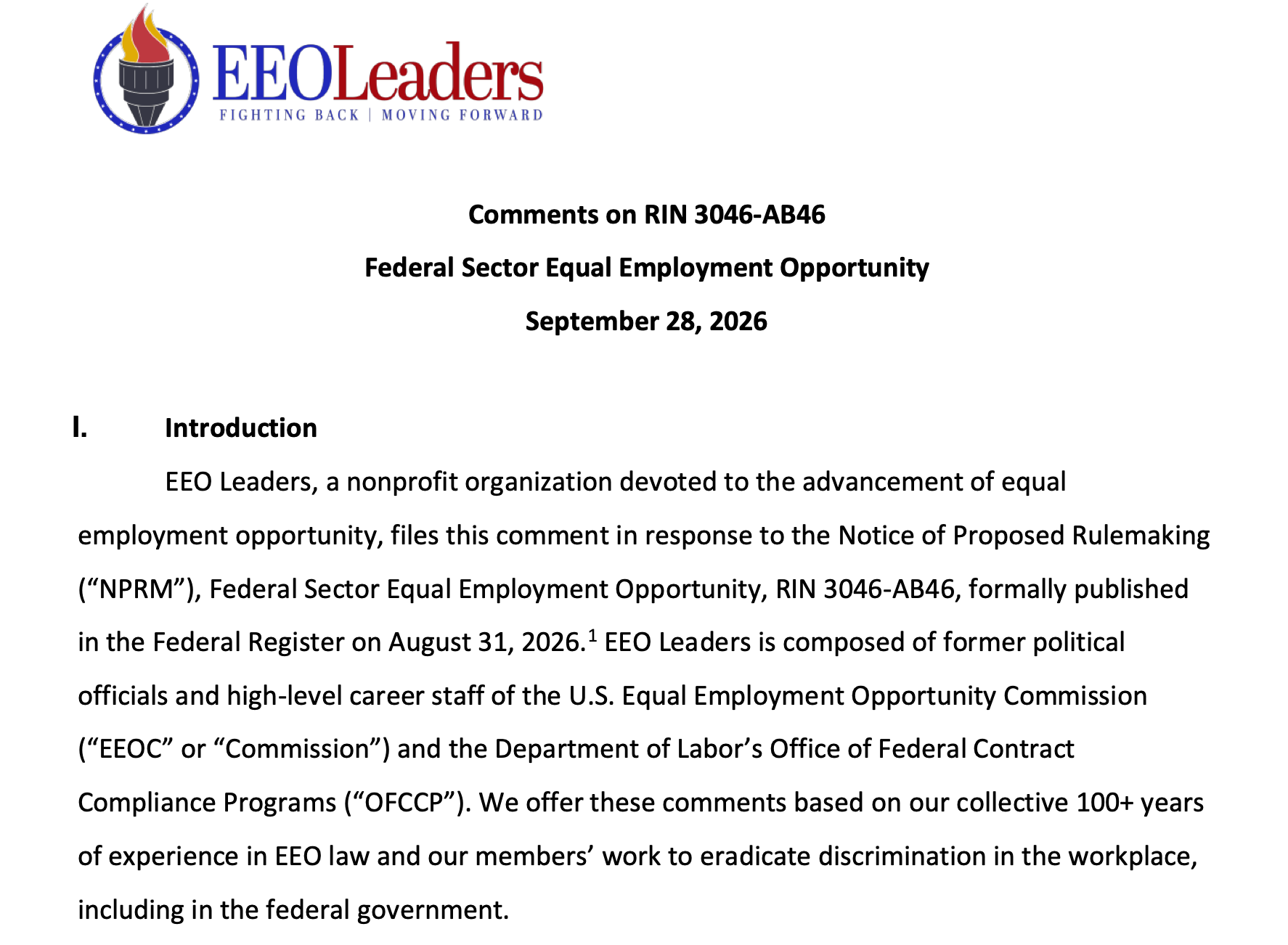
But as the attached comment from EEO Leaders explains, the EEOC’s proposed rule will make this process more difficult, biased, and expensive for federal employees. The EEOC’s proposal does not improve the system; it eviscerates essential aspects of it.
For example, the proposed regulation would undo existing protections that give federal employees some opportunity to bring their claims before unbiased decisionmakers. Current regulations allow a federal employee to ask for a hearing before an impartial EEOC Administrative Judge before the agency makes its final decision. But the proposed regulation would rescind that right; instead, the EEOC would decide if a complainant “deserves” a hearing or should be forced instead to rely on the putative good will of the agency that the complainant has accused of engaging in discrimination.
The EEOC also wants to eliminate the right for federal employees to bring class action complaints in the administrative process. Such complaints are the most effective and efficient way to challenge widespread discrimination – the kinds of discrimination that are implicated by many of the current attacks on the civil service. But the EEOC now claims it doesn’t have the capability to handle class complaints – ignoring both the EEOC’s decades of experience adjudicating these complaints and controlling case law that class complaints must be allowed in the federal administrative process.
The EEOC would also eliminate a counseling stage in the process that has helped thousands of federal employees by providing them advice about, and potential early resolution of, their workplace claims. The EEOC claims this counseling stage is too burdensome and not helpful, but it clearly hasn’t listened to EEO offices about the usefulness of counseling.
Weakening this process is not happening in a vacuum. It comes against a backdrop of persistent discrimination against the nation’s civil servants. News reports have explored mishandled sexual misconduct at the Drug Enforcement Agency, the Federal Deposit Insurance Corporation (FDIC), various locations of the National Science Foundation, and the Department of Homeland Security, among many others. Women and people of color have been disproportionately affected by removals at the Federal Bureau of Investigation. This is precisely when we need a strong anti-discrimination system–not a broken one.
Federal employees dedicate their work to improving the lives of Americans. They deserve far better than to be punching bags for this administration. The EEOC should abandon this latest assault on the civil service and federal workers’ ability to vindicate their rights to be free from unlawful discrimination.
Today is the last day for the public to submit comments on the proposed regulation, and we strongly encourage you to do so (you can submit them here). We invite you to use any of the points we make in this piece or in our comment.
(If you’re a current employee and choose to comment on the proposed rule, you don’t have to identify yourself as a current employee. If you choose to identify yourself, you should state that you are writing in your personal capacity, not your official capacity. Current employees should only comment on your own time and using your own personal computer.)
Jocelyn Samuels joined DOJ’s Civil Rights Division in 2009, which she led as the Acting Assistant Attorney General from 2013-2014. She later served as a Commissioner and Vice Chair of the EEOC, having been nominated in 2020 by President Trump – who later fired her in 2025. Chai Feldblum was a Commissioner of the EEOC from 2010-2019 and worked extensively on the federal sector process during her tenure on the Commission. They are now, respectively, the Vice President and President of EEO Leaders, an organization of former EEOC and DOL officials formed in 2025 to monitor and hold the Trump Administration accountable for its attacks on workplace anti-discrimination standards and enforcement.

